
Is Your Dental Practice Overusing Excel? The Real Price of Using Spreadsheets
It is versatile, well-known and simple to implement.
What happens if you make Excel into your practice’s back office management system?
Therein lies the danger.
From one spreadsheet to five
Typically, it all begins harmlessly enough.
The practice requires some way to keep track of holidays for its staff.
So, someone makes a spreadsheet.
And another spreadsheet for attendance.
And another one for hours.
And another for payroll changes.
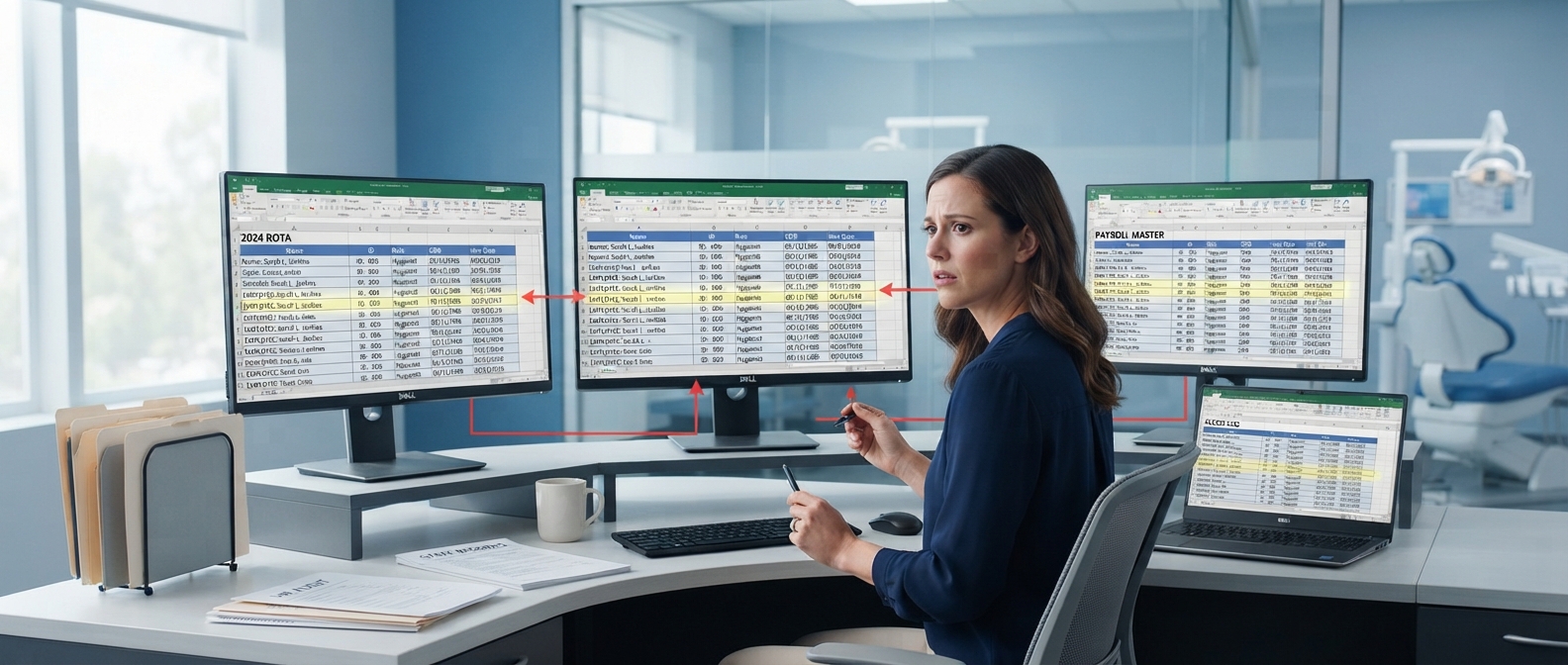
And before anyone knows it, the practice could be running several spreadsheets filled with information that is linked together, but not linked together at all.
Again, the problem does not lie in Excel.
The problem lies in treating spreadsheets as an alternative to a back office management system.
The hidden risks
1. Duplicate information
The same staff member’s information may appear in multiple spreadsheets.
If their working hours change, does everyone remember to update every spreadsheet?
2. Manual calculations
A formula can save time until somebody changes a cell, copies information incorrectly or introduces an error.
The larger the spreadsheet becomes, the harder it can be to identify mistakes.
3. Limited visibility
A spreadsheet may tell you what happened.
But management often needs to understand what is happening now and what requires attention.
4. Knowledge sits with one person
If only one person understands how a complicated spreadsheet works, the practice has created a dependency.
5. Reporting takes time
When management asks for information, someone may need to open several files, combine figures and prepare a report.
That is administration that could potentially be reduced.
At what point does a practice need to consider a back-office system?
There is no magic number of employees or number of surgeries that would mean a practice needs to consider a change.
Rather, it will depend on how much administration is being done.
If your team is continually saying:
“I’ll have to check the spreadsheet.”
Or
“I’ll need to calculate that.”
Or
“I think that information is in another file.”
then you may need to consider the process.
Excel is not the problem
Using Excel in the right place is perfectly fine.
The question is whether your practice is using Excel as an efficient solution or relying on multiple spreadsheets to achieve what a good management system would achieve.
Centralised information can prove very valuable for a growing or multi-branch practice.
The benefits of a dedicated dental back-office system
Using a dedicated dental back-office system can help to structure such things as financial information, attendance, rotas, staff information, performance, and compliance management.
This could be achieved by having all authorised users working from the same centralised information.
This could lead to:
Reducing duplications -> Reducing manual processing -> Improving visibility -> Better management.
The cost of the spreadsheet is easy to quantify
Using Excel is free.
The challenge is quantifying the cost of maintaining spreadsheets.
If a practice manager spends a few hours per month maintaining, checking, preparing reports, etc., then there is a cost for the business.
And it is a recurring cost.
A simple exercise for your practice
For one month, measure how many hours your team spend on the following:
Maintaining spreadsheets
- Attendance management
- Rota management
- Hour calculation
- Preparing reports
- Checking staff information
- Calculating adjustments
- Searching for documents
- Preparing compliance information
Add up the hours.
You may be surprised with the results.
Sometimes the greatest digitalisation opportunity is not within the clinical area.
It is hidden in the back-office.
Conclusion
The question is not:
“Can Excel do this?”
The answer often is yes.
The better question is:
“Do we really need to waste time on this task?”